Monday, July 14, 2025

DM Bob: White Trash Meets Euro Trash (2011)

NOTE: This is an interview I did for the defunct WMSE blog, Sonic Diet, back on Sept. 12, 2011. It doesn't appear DM Bob (Bob Tooke) has had any new releases since this album, but according to his Facebook, he was still doing shows in Germany as DM as late as last fall.


A new DM Bob & the Deficits album is always reason to beat on your bucket and rejoice, and their latest, the not-so-lost They Called Us Country, is certainly no exception. As always, the band, which has recorded for Crypt and Voodoo Rhythm Records among others, is loose and sloppy but with a driving swagger that hooks you and sends you swirling in trashy/fuzzy/sleazy goodness. The newly released recordings, which stem from around 1999-2002, burn the honky tonk down with revved up and refreshed covers of Buck Owens, Al Ferrier, and the Velvet Underground as a well as a handful of excellent originals including “Don’t Give Me Nothing” and the sequel to “Hooker Bones.” DM Bob (Bob Tooke), a transplanted Louisianan who also is noted for his paintings, recently took time to respond to respond to my questions from his home in Hamburg, Germany.

How did They Called Us Country come to be a “lost” album? How did it make its way to Germany’s Off Label Records?

At some point after the band broke up, I simply collected this group of songs that sort of fit together with our country side. Every now and then someone would call us a country band – hence the album title – later I started doing Sanford Clark’s version (kind of) of “They Call Me Country.” This LP isn’t really a lost record (those weren’t my words) – more like a dormant demo! A couple of years ago I got a single (vinyl 45!) of The Dead Horse Experience from Off Label in the mail (which was quite nice of ‘em). So, then I offered Johnny Hanke the chance to listen to my dormant demo and he was kind enough to take the dare and put it out. Wonderful production on Johnny’s part!

The title comes from your excellent cover of the Sanford Clark obscurity “They Call Me Country” on the album.  You have great taste in covers (Hasil Adkins’ “Yard Sale,” T-Rex’s “Jeepster,” Johnny Paycheck’s “Slide Off Your Satin Sheets,” Velvet Underground’s “Satellite of Love,” etc.) and deliver distinctly enjoyable interpretations. How would you describe your approach to picking and performing cover songs?

Thanks for this compliment-filled question!  The way I see it it’s sort of traditional, respectful, R&R! and Fun! to do interpretations of other peoples’ tunes – it was certainly what I experienced growing up in south Louisiana. Anyway, I’ve never had any problem with it. I suppose “the art of covering” sort of solidified when the BushHogs were formed in 1986 (with Rick Olivier and Charles Franklin – the band still exists in New Orleans – we play once a year – only Red Deveca has been on bass since 1990).  Rick and I would trade off on guitar and drums and both of us had this strong desire to play all this killer Louisiana music that we were constantly discovering (starting around 1977) – we sort of had this attitude toward not doing original stuff – not to say that all the great songs have been written – writing just seemed pointless to us back then –  of course we took perhaps too much liberty with some tunes – but in general we were simply paying tribute to our mentors (the list is too infinite to mention). In the end, I’d say I’m simply indebted to recorded music.

I understand you are originally are from Louisiana. How did you end up living in Hamburg, Germany, and become DM Bob? Are there ever any “cultural misunderstandings” with fans or others there that like your music but maybe don’t get the references?

Yeah, I’m from Raceland, LA – 35 miles west southwest of New Orleans – supposedly there was once a horse racetrack in Raceland but I’ve always doubted this story – anyway yeah born on the bayou (we did have decent radio back then). How I ended up in Hamburg is “the same old story” – it was because of the love of a woman (I met my ex at a BushHogs thro-down in NO in ‘89). I moved to Hamburg in January ‘91- flew over on the very day the first Gulf War started. It was difficult at first, but in less than a year I found folks to make music with – Hamburg, like New Orleans, is a music city but of course I was confronted with a somewhat new take on things – different tastes, attitudes, styles etc. – lots of stuff I wouldn’t have experienced had I stayed in Louisiana ( perhaps I’m a white trash/euro trash combo).The Deutsch-Mark name story is too long to tell here, but basically it was suggested by the artist Todd Severson (a friend who like me ended up living in Germany – he also wrote the lyrics to Hooker Bones – 1 and 2) – anyway the name was suggested because of my hustling music and paintings plus my general interest in “political economy.” Yes, there were a few “cultural misunderstandings” especially playing some country stuff in Germany – we used to play Johnny Paycheck’s “Apt No 9” and this one for some reason left  the audience consistently cold and playing in the former DDR and often left me saying “they don’t get it” after a show.

Your recent work has been with Jem Finer (a founding member of the Pogues) and the Watzloves, but you are still playing with the Deficits some, right? Any plans to come to the U.S. or to record new music?

Jem and I did two really special albums and a lot of shows in the UK and Germany, but he lives in London and is very busy with his multitude of art projects. I got the Deficits back together for a one-off record release party and we ended up doing two. I’m afraid the Deficits won’t turn into a regular touring band again unless we get a generous offer or play somewhere not too far away – we might yet make it to Berlin or Bremen – I hope so. The markets will decide I guess. The Watzloves are about to start making plans for some U.S. activity – it hasn’t been worked out yet but it would be in LA/TX – for the most part – “a gallery circuit” – basically doing as many gigs as we’re offered between NO and Marfra, TX. I’m now in the process of finishing up recordings of/by “DM Bob & Speedy Jake” – Jakobus (aka S Jake). He once played steel and trombone in the Watzloves. Anyway, now he is a master of the tuba, which compliments my onemanband set up right on. We are finalizing recent recordings plus Silky has a big bag of killer tunes that will be attended to in winter. Yes! Always recording! (thinking about changing the name of the next combo to “Euro Bob and the Sea-Bells”)

You were on the John Peel show twice. He actually sang Merle Haggard’s “Lonesome Fugitive” with you on one of the appearances. What do you remember about that experience?

We did a Deficit session and I did one with Jem for J Peel. He also did a film for BBC TV called “On the Road with John Peel” and the Deficits were fortunate to be included (this was before our first JP Session).  It was a stroke of luck that “Lonesome Fugitive” was one of his favorite songs – he said he used to sing this to his children when they were on the road. Maybe that’s why we got invited to Maida Vale (the amazing BBC recording facility)!  Of course if I hadn’t moved to Germany I would have never met John – it was something very special and wonderful – he was a wonder to music. He told me during the “Lonesome Fugitive session” that he got his first real radio DJ gig in Dallas, TX! – “It was the 60’s and I had the accent.”

The Deficits are very much associated with Crypt Records. Do you keep up with label head Tim Warren, who now lives in Berlin?

I must say Tim Warren and Crypt Records are very “instrumental” for the Deficits – it was really by chance that we landed a contract with Crypt (and yes, he did it up proper) I am in contact – I usually see him when I go to Berlin – we met up just a few weeks ago at Silky Watzlove’s last exhibition – he was there with his dog Roky – he has a fantastic pad in Berlin – relatively happy – doing fantastic mastering and tending to his emporium.

Were you really sued for infringement by the company that owns the Bush Hog trademark after your Bush Hog’N Man album? 

Well, we weren’t never sued – it was one of those “cease and desist” letters – I forgot the name of the corporation that owns the Bush Hog Co. but they didn’t have a case – but of course Tim became a bit nervous and asked me to write a “letter of defense.” Anyway, I explained that the phrase “bush hogging” has long been a euphemism for mowing in the south (even with a lawn mower!) and that actually I was paying tribute (in their letter they said that they didn’t find the song positive to their trade mark – what an insult!) I mean really!  Are there any words one can’t use to write a song?! Seems safer to stick to the covers but the next letter might come from the corporate law firm of Lou Reed!


Sunday, April 13, 2025

Nashville Pussy: They Scare You Some (1998)

Note: I reached back to the 20th century for this old article. This review was published April 26, 1998 in The East Carolinian, the student newspaper for East Carolina University. All my memories of Nashville Pussy shows are fuzzy yet still fiery. Hope you enjoy this, and I was happy to see Nashville Pussy is still on the road performing. You can see them July 9 in Lichtenfels, Germany. Also, don't miss Blaine Cartwright's work with the fabulous Miss Georgia Peach; they have a barn-burning new album out on Rum Bar called Class Out the Ass.


Wednesday, March 19, 2025

Baseball Season is Upon Us; Long Live the Baseball Project (2023)


(NOTE: I wrote this article for the Shepherd Express back on Aug. 28, 2023. We are just about a week away from Opening Day 2025 on Thursday, March 27, so it seemed like a baseball-related story was appropriate. It doesn't appear that the Baseball Project has any upcoming dates or new music; however, The Minus 5, featuring several of the same musicians and "captained" by the same man, Scott McCaughey. has a new album, Oar on, Penelope!, out May 30. They have a slew of tour dates, too, but nothing in Milwaukee yet.
)

Baseball box scores are disappearing (even whole sports sections actually) from America’s newspapers, and viewership for the sport continues to rapidly decline, but one band is still fighting the good fight to spread the word about the grand old game.

The Baseball Project is back with its fourth album, Grand Salami Time!, and returns to Milwaukee tonight at Turner Hall.

The supergroup, featuring Scott McCaughey, Linda Pitmon, Peter Buck, Mike Mills and Steve Wynn, came together for the album after releasing its last album in 2014. Several factors caused the nine-year gap between Third and Grand Salami Time!, including the members’ busy schedules with various other musical efforts, unsuccessful recording attempts, the pandemic, of course, and McCaughey’s stroke in 2017.

Finally last year, they joined with producer Mitch Easter at his Fidelitorium Studios in Kernersville, North Carolina, to record the new album. The experience was a reunion for Mills, Buck, and Easter, who famously produced some of R.E.M.’s earliest efforts, as well as bands like Let’s Active, Game Theory and dozens more.

Scene of Earlier Triumphs

Being in the studio with Easter, recording again with the Baseball Project after all the time, and “bringing Mike and Peter to the scene of their earlier triumphs,” was amazing, says McCaughey.

“It took a lot of effort to get to that point,” he says. “It was tricky, but we managed. But it was worth the wait I think.”

Worth the wait indeed. Grand Salami Time is filled with fun rock songs (experiencing a low ebb like baseball), like the boisterous, brain busting title track that opens the album, stringing together “genius/knucklehead” catchphrases from announcers: “Everybody's got a favorite catch phrase, my oh my/Clear the deck, cannonball coming, you can kiss it goodbye/Now the sacks are drunk and so am I, so am I/Get out the rye bread and mustard grandma, it's grand salami time!”

A song with so many words might be hard for anyone to remember, but it’s particularly impressive for McCaughey, yet no less difficult, he says.

“I’ve have a lot of trouble anyway remembering words since I had the stroke,” he says. “That one is really, really hard. It’s so rapid-fire, one thing after another, and they don’t really make sense. It’s a real struggle, but I’m getting pretty good at it now.”

Ball Four

Another standout track is “64 and 64” about pitcher Jim Bouton, who wrote the notorious Ball Four, an inside and sometimes unflattering look at baseball players that served to inspire McCaughey, who says there might not have been a Baseball Project without the book. He explains that he and Wynn bonded over the book at the start of the band.

“He was talking about Ball Four and what a great book it was, what a great source of stories it was, and how it really changed how he thought about baseball as a kid,” McCaughey says. “You know, we love the sport. We’re crazy about baseball. At the same time, we realize not everything is right with baseball, not everything is perfect with the characters who play baseball. We kind of make it pretty obvious that we were going to write songs that were maybe a little unsavory about baseball.

“A lot of them are like, yeah, this was a great player. But we also wanted to be true to ourselves and true to the game, which Bouton kind of exposed a little bit when he did Ball Four.”

An earlier Baseball Project song, the incredibly catchy “Ted Fucking Williams,” written by Buck, was also inspired by Bouton and Ball Four, McCaughey says.

The band’s Bouton-inspired approach has not kept away Major League Baseball. Several teams, including the Brewers, have invited the group to perform at their stadiums. The Baseball Project sang the national anthem at then-Miller Park on July 27, 2016, during a tour they did with Milwaukee/Minneapolis band The Woolridge Brothers.

“We’re big Brewers fans,” says McCaughey. “I wrote a song for the third album called ‘82 Brew Crew,’ maybe we’ll put that out some day.”

McCaughey has other connections to Milwaukee. After his stroke, it’s one of the first places he played when he was able to go on the road again. The Baseball Project did a series of shows in Milwaukee, Madison Chicago and elsewhere in the Midwest.

“I really associate that with the Baseball Project and the Milwaukee and Madison area,” McCaughey says. “I remember how exciting it felt, and people came out and were really wishing me the best. They were really moved that I was there, and I was moved that I was there.

“I didn’t know I would ever get back to the point of being able to travel. I was really thankful for everyone who came out and made me feel so good.”

Monday, December 23, 2024

Freak Show Forecast (2018): Scrooged


Note: Here's a quick one from Christmas and Freak Show past. I wrote this preview for WMSE in December 2018. The Friday Night Freak Show has moved from the Times Cinema to the Oriental Theater, and the next screening is Labyrinth on Jan. 10.

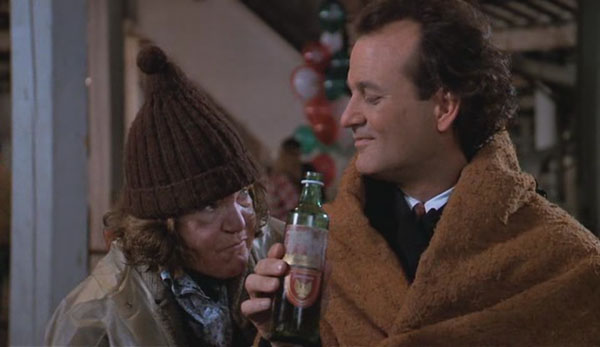
Half the fun of Scrooged (1988) is seeing which dead star will pop up next in the movie: Robert Mitchum – that’s right! Buddy Hackett – indeed! Miles Davis – no, shit! And there’s plenty more where that comes from – and by-gawd the Solid Gold Dancers!


So much has already been written about Scrooged, which turns 30 this year, but here are some ponderable tidbits for your Freak Show viewing:

  • David Johansen is a blast as the taxi-driving, Bobcat-booze-snagging Ghost of Christmas Past. But his former bandmate in the New York Dolls, Arthur “Killer” Kane, had fallen far from the limelight when he saw Johansen in his Scrooged role while watching television. In his excellent 2005 documentary about Kane, New York Doll, Greg Whiteley uses Johansen’s appearance in Scrooged to frame Kane’s trip to rock bottom and subsequent recovery and reunion with the New York Dolls. It goes something like this: Kane sees Johansen in Scrooged; he get incredibly drunk on Peppermint Schnapps; he assaults his wife; his wife leaves him; he jumps out of his apartment window, leaving him alive but with permanent damage to his body; he converts to Mormonism and goes to work at a Mormon library, where he is loved; more things happen; Morrisey says, “Hey, the New York Dolls should reunite”; and the New York Dolls reunite. Sadly, Kane would die just a few weeks after the reunion shows in 2004.

  • Screenwriters Mitch Glazer and Michael O’Donoghue adapted Scrooged for the screen from Charles Dickens’ oft visited A Christmas Carol. Most famous for his work on Saturday Night Live and the cult spoof, Mr. Mike’s Mondo Video, O’Donoghue was a major meanie about the finished movie. He is quoted in The Big Bad Book of Bill Murray, calling Scrooged a “piece of unadulterated, unmitigated shit.” “The only good thing is that big checks came out of Scrooged, which allowed me to get a home in Ireland,” says O’Donoghue, who died in 1994.


Saturday, November 9, 2024

On Commodity Cheese and Bo Diddley’s scooter: Norton Records hits 25 (2011)


NOTE: This Q&A originally appeared on WMSE's now defunct blog, Sonic Diet. Sadly, Billy Miller passed away in 2016. Meanwhile, his wife and business partner, Miriam Linna, has continued Norton Records, started the awesome Kicksville Radio, and is currently resurrecting the legendary Kicks Magazine, to name just a few wonderful things she puts out in the world. It seems the show I mention has disappeared from the WMSE site, but here is my playlist to honor the label hitting 25.

Gino Domenico/Associated Press


Without hesitation, I will tell you that Norton Records is my favorite label. Where else would I have been turned on and corrupted all these years by the likes of Hasil Adkins, Link Wray, T. Valentine and the Flat Duo Jets or found out about the Readymen, Ron Haydock and the Figures of Light? The New York-based label was born out of Kicks magazine in 1986 by Miriam Linna and Billy Miller. The husband and wife duo, who just released their 200th LP on Norton and have put out another 300 45’s, also perform together in the A-Bones. They’ve even started a publishing arm, Kicks Books, to spread the Norton gospel to the literary world. Miller and Linna were kind enough recently to respond to a few questions, which you can read below. I will pay tribute to Norton’s anniversary today on Zero Hour from noon to 3 p.m. Tune in and don’t forget to pledge! 

What does it mean to you personally for Norton to hit 25? If you were to be awarded some sort of rock-n-roll memento to recognize your anniversary, what would you wish for? 
Miriam Linna: It doesn’t feel like 25 a-tall. Feels like 25 weeks. Seriously. The Capitol tower. 
Billy Miller: Bo Diddley’s scooter. 

How difficult was it to put out your first release, Hasil Adkins’ Out to Hunch? How many copies were initially made? 
BM: We had somewhat of a built in audience though our Kicks magazine coverage of Hasil and we had plenty of his tapes to choose from. We originally made 500 copies. 

Was there ever a time in the early history of the label when you thought about not continuing? Were there other labels or people at the time that you looked to for guidance or inspiration? 
BM: We never considered stopping. There’s always more projects than time, actually. We were friends with Donn (Fileti) and Eddie (Gries), who had the doo wop/R&B label Relic and they answered a lot of our questions. But we didn’t pattern Norton after any label in particular. 
ML: We’ve had some really challenging times, but we’ve not ever considered stopping. The guys at Relic were the people we looked up to the most. 

What has been your biggest selling release? 
BM: Here Are the Sonics!!! Over the years, Norton has uncovered an incredible amount of wonderful, forgotten music. 

What do you look for when deciding if something might make a good release? 
ML: Personally – my favorite realm is the unknown. Totally unknown old music, at least unheralded and unissued! I HATE it when people call us a reissue label. That’s the last thing we want to be. 

In the past few years, Norton has put out excellent albums and 45’s by the Tandoori Knights, Girls at Dawn, Bloodshot Bill and other current musicians after a period without many new acts joining the roster. Did you ever consider focusing strictly on reissued material? 
ML: Watch that “reissue” tag, Andy. Old stuff is where we are at but when new artists come along with their heart and sound in the right place, we’ll see their sounds out on Norton. New stuff not the norm for Norton. 

How would describe Norton’s influence on independent music/labels over the last 25 years? 
ML: Jeepers, dunno. If anything, to encourage people to listen to decent music and to love 45’s in particular. To give unknown recordings a chance, to realize that popular does necessarily not equal good, then again, neither does obscure. If you can glean the heart and soul of a crazy little Norton record by some lunatic you never heard of, then the job is done, and if you can dig the back story of that record, then we’re all the better for it. 

What new or upcoming releases can you tell me about? What else is on your slate? 
ML: Six volumes of Southwest mayhem – unissued stuff, super scarce recordings – which grew out of the volumes on Long John Hunter and Bobby Fuller. Giving the SW the same treatment as we gave the NW with the Sonics, Wailers, and loads of unknown Northwest combos from the late 50s thru about 1966. Also, finally, the Del-Aires collection will come out, the guys from Horror of Party Beach. The Del-Aires, like so many Norton releases, were originally hatched as Kicks magazine stories that just growed. Kicks mag may be gone, but Kicks Books paperback line is just beginning, hatched from Andre Williams’ rehab sensation Sweets. Next up, This Planet is Doomed (Sun Ra), followed by Save the Last Dance for Satan (Nick Tosches) followed by Pulling the Train (Harlan Ellison) followed by Kim Fowley’s trilogy! Look out, glittering illiterati! 

Words of advice for someone starting an independent music label? 
BM: Don’t expect your day to end at 5:00. 
ML: We never went into it as though we were starting a label, so we don’t have advice by experience. The first album – Hasil – was a one-off to feed the frenzy after the Kicks story… then Esquerita popped out of jail and landed in our laps and suddenly, we had two albums. It kind of just mushroomed. We had day jobs for the first ten years of the label, if that says anything! It’s a different world now, maybe easier with the internet and communication being fast, free and easy, but on the other hand, there are the same trials with actually making a piece of plastic, or 500, and getting them sold. I guess that’s easier now too with the electronic world we’re living in. Aw heck, advice would be don’t bite off more than you can chew, be prepared to eat commodity cheese for a long while. 

Monday, September 23, 2024

Jerry Lee Lewis: Lost and Found (Continuum Books, 2009), by Joe Bonomo


Note: I wrote the following book review for Country Standard Time way back in November 2009. In my most recent Turner's Picture Palace, I wrote about a more recent take on The Killer, Ethan Cohen's fab 2022 documentary, Jerry Lee Lewis: Trouble in Mind. You can follow Joe Bonomo's writing at https://joebonomo.substack.com/ or purchase the book here.


Have you ever left a concert buzzing and beaming, sweaty and soul-fried, awakened, made a true believer - an overwhelming feeling in your gut that you just witnessed musical history? Joe Bonomo certainly has and he's never forgotten. It's with this spirit he skillfully investigates what some call one of the greatest rock-n-roll performances of all time, Jerry Lee Lewis' April 4, 1964 show at the Star Club in Hamburg, Germany.


The resulting album, "Live at the Star-Club Hamburg," despite being highly revered by fans and other musicians alike, is currently not in print in the U.S. (it is available from Germany-based Bear Family on compact disc and on a newly released vinyl version). The performance, dubbed the "very essence of rock & roll" by allmusic.com, serves as the centerpiece of Bonomo's book, which follows Lewis mostly from the period after his 1958 wedding scandal to a pre-teen cousin through his success on the country charts in the late 1960s and early '70s.

A professor at Northern Illinois University and author of a wildly entertaining book on The Fleshtones, Bonomo is a capable researcher and engaging writer who often shares his experiences as a music fan to good effect. His introduction to Lewis as a pre-teen in the 1970s came through a budget-line LP compilation with a lifeless, re-recorded version of Breathless that left Bonomo with little appreciation of the Killer, who he decided was "strictly Fifties and strictly out of it." He would later learn, of course, to appreciate Jerry Lee, but the youthful experience helps him consider the theme of "sincerity" and Lewis' "battles" with it, which he explores throughout "Lost and Found."

Bonomo also recalls great live shows he's attended from the Rolling Stones to the New Bomb Turks and the small number of great live albums he's listened to. He writes, "Until a live album ... can replicate tinnitus or a chest full of illicit smoke or the helpless urge to grope the painted-on Jordache ass of the girl standing in front of you, a live album risks failure." The celebrated Star-Club performance is detailed extensively from the seedy section of Hamburg where it occurred to the career of Lewis' backing band that night, the Nashville Teens.

Enlightening interviews abound including producer Jerry Kennedy, the recently departed Shelby Singleton and Jim Dickinson, and contemporary artists such as Dave Alvin, John Doe and Jim (Reverend Horton Heat) Heath. The Killer himself would not agree to be interviewed for "Lost and Found," and while his audacious voice is certainly missed, Bonomo has managed a thoroughly exciting and thoughtful story that should delight both Jerry Lee Lewis fans and anyone who's had their world shook up by a live performance.


Thursday, September 12, 2024

Turner's Picture Palace: August 2024


For seemingly forever and a day, we’ve lived in a sequel-saturated, this-that-and-the other cinematic universe/IP world, so it’s fun to read some anonymous reporter in a 1936 edition of the Altoona (Pa.) Tribune bitching about there being too many goddammed vampire movies since Dracula strolled into Hollywoodland: “When Universal made Dracula a few years ago, there was no way of knowing that the wraiths of every vampire that ever scared an old maid would come out once more from the dark corners of the earth. However, they swooped in great numbers on the wings of night, to cast their shivery shadows almost endlessly on the theatre screens of the world.” Written in response to Dracula’s Daughter appearing in old Altoona, the article ends hopefully that this silly sequel business might finally be done: “Perhaps Dracula’s Daughter will set the wings of superstition at rest and take the claws out of the vampire.”


But of course, I watched Dracula’s Daughter on Universal’s Dracula: Complete Legacy Edition Blu-Ray collection, which over six films, captures Drac’s doings in the Golden Age-time period before and after this Altoona (character) assassination. And I loved it, lured in by Gloria Holden’s nightmare eyes and broken soul, the moody and sensuous black and white cinematography of monster movie master George Robinson, and the delightful abundance of snooty British humor. Maguerite Churchill is stunning and often hilarious as psychiatrist Jeffrey Garth’s fiancée and secretary, Janet, who often seems like she has just escaped from a screwball comedy set.


Meanwhile, the Sydney (Australia) Morning Herald dismissed the movie as nonsense, but seemed to have a much firmer handle on sequels and Hollywood: “Students of Bram Stoker will know that this should be final; and that there’s no fear of the future appearance of Dracula’s granddaughter. But students of Hollywood will not be quite so sure.”

Yes, I watch too many movies, but I also own way, way too many, including an always-growing pile of box sets. In addition to the Dracula box set, last month I focused on digging into box sets from Arrow, Severin, Vinegar Syndrome, Criterion, and others. Some of my favorites included my first “Bruce Li” movie (the charismatic and highly appealing Bruce Liang), Bruce and the Iron Finger (1979, not to mention a scene-stealing, ride-em-cowgirl performance by Nami Misaki as a kinky villain), Melvin Van Pebbles’ life-affirming Don’t Play Us Cheap (1972), the mind-blowing Voodoo Heartbeat, aka, The Sex Serum of Dr. Blake (1970), and If Footmen Tire, What Will Horses Do? (1971, more below on that).


Killer: As I watched Jerry Lee Lewis: Trouble in Mind (2022), loving every second of the Ethan Cohen documentary and it’s all Jerry, all the time approach, I wondered if the notoriously God-fearing but hell-raising Lewis had seen If Footmen Tire, What Will Horses Do? as it made its way around Southern churches and community centers. Surely, he would identify with its we’re-all-going-to-hell-because-of-our-heathen-ways message and its deliriously unhinged, bloody way of telling it. But then I consulted my copy of Nick Tosches’ Hellfire : The Jerry Lee Lewis Story and was reminded that in 1971, Jerry Lee lost his mother; his divorce with Myra Gale Lewis was finalized; she married the private dick who had investigated him and his lyin, cheatin’ ways; he was sued for allegedly attacking a woman at a Memphis supper club; and, finally later in the year, he got remarried –  and separated two weeks later. So, a busy man, a beat (but not out) man. Not much time to think about communist invasions and infiltration. Tosches captures this sad, sordid tale in a chapter with the fantastic title “The Secret Parts of the Night.”


The King of Cult’s Little Brother: I came to The Cat Burglar (1961) through Roger Corman’s The Intruder (1962), a movie I rewatched in August with my movie club, again struck by the performance of Leo Gordon, who is such a strong part of an incredibly fierce, tough movie. Gordon served as a screenwriter for several Corman movies, including The Wasp Woman, The Terror, and Tower of London and had numerous other writing gigs and an extensive acting career. He also worked with Gene Corman on The Cat Burglar (at one point was to be called The Case of the Black Book) – a ripping crime tale, filmed on location in L.A., depicting the downfall of a minor criminal with a code who tangles with spies and thugs over a briefcase containing some sort of dastardly Cold War-formula. Goes down easy over 65 entertaining minutes. Said The Anniston Star: “Producer Gene Corman’s conviction that realistic stories call for complete set realism, resulted in the film’s feel of urgency and suspense which Leo Gordon’s taught script demanded.” Gordon and G. Corman teamed up again in 1967’s pro-flamethrower Tobruk, a movie R. Corman would borrow from frequently, starring Rock Hudson and George Peppard, and 1970’s You Can’t Win Them All with Tony Curtis and Charles Bronson.

Other crime favorites from the month included Dead End (1937), Hayseed (2023), Blonde Ice (1948), Shadow of a Doubt (1943), and Mystery Street (1950), all first-time watches. There’s a fascinating story about Frances Glessner Lee, a female forensics pioneer who was involved in the real life story behind Mystery Street in a recent Boston Globe magazine article – unfortunately, behind a paywall.


At the Movies, Mostly Blah: I had much less success in theaters in August than I had in July, but I didn’t make it to a couple I wanted to see (I’m looking at you, Strange Darling and Sing Sing). What I did see largely left me cold, slightly entertained sometimes, or annoyed: I’m trying to not look at you, Borderlands (2024), Blink Twice (2024), and Mother, Couch (2023). I did enjoy watching Coup! (2023) 1 ½ times – thanks to the summer storm that knocked out power to the theater during my first viewing. It’s a pandemic movie set during that other pandemic, the Spanish Plague, with characters and motivations that could have been ripped out of current news stories and social media posts. In the lead role, Peter Sarsgaard absolutely carries the movie, but Sarah Gadon is also memorable as the sensible wife of a pompous fake played by Billy Magnussen (stay out of his pool, peasant, or there will be consequences). 

I had better luck streaming new and newish movies, especially Al Warren’s Dogleg (2023) on Mubi. You’ve seen the set-up before: various seemingly unrelated segments coming together at the end (Slacker, Short Cuts, etc.) Warren’s film has plenty of its own pleasures, especially Warren as Alan, a “balding film director,” who loses his girlfriend’s dog at a gender reveal party. We see the indie movie within an indie movie he’s making and the diverse characters he meets as he attempts to locate “Roo.”


Black and White – and, yep, Deadly: I also managed to watch a handful of black-and-white horrors (dare I go all black and white for my annual all-horror October –yes, I will!) and two that stayed with me the most were Alex Nicol’s The Screaming Skull (1958) and Jean Yarborough’s King of the Zombies (1941). Neither movie was especially what you might call good, but both are highly watchable in their own ways (and besides, when the hell has “not good” stopped me?).

The Screaming Skull’s low-budget thrills contain zero ounces of fright, but they look pretty damn cool. I also guess I hate-watched it too, hoping for the condescending, mansplaining Eric Whitlock (portrayed convincingly assholish by John Hudson) to get his. Spoiler: he gets his. A column by Dick Williams in the June 28, 1958 Los Angeles Mirror reported that American International Pictures “Prexy” James Nicholson had recently screened The Screaming Skull and Bert I. Gordon’s Attack of the Puppet Master at his home for his teenage daughters and their friends. Mr. B.I.G., and his then wife Flora were even in attendance. Reported Dick: “The twin bill fared well. But Nicholson says they don’t hesitate to give the horse-laugh to anything they don’t like or consider phony.”


The pleasure of the cheap, cheap looking King of the Zombies almost exclusively comes from watching Mantan Moreland perform. He is consistently funny and truly captivates in every scene he’s in, which is, fortunately, most of ‘em!  The movie is unquestionably racially insensitive, and it offers interesting insight to read coverage of the movie in Kansas City, Missouri’s African-American newspaper, The Call, from when King of the Zombies appeared there in August 1941. In its review, The Call notes Moreland’s popularity, writing that he is “second only to Rochester in fan mail.” Legendary actor and comedian Eddie “Rochester” Anderson’ was a regular on Jack Benny’s radio program at the time. Other news in The Call that day was decidedly darker. Lewis Gordon, a 40-year-old prisoner in Trenton, Georgia, died after being crammed in a  7-by-7 ½ cell with 22 other prisoners who had been protesting because of conditions at the prison camp: “It developed in the testimony that guards were asked repeatedly for an hour and a half before they were released, to take Gordon out because he was dying, but they laughed.” 

In June 1973, Moreland was interviewed by The Independent in Richmond, California. He talked about how fellow Monogram Pictures actor Frankie Darrow, who would later work as a 5-foot-3 stuntman, a “kid actor” at the time, would get beat up and bruised frequently for defending Moreland every time someone called him a “Black something or other.” But Moreland said he still would have done it the same way: “Sure, I used to roll my eyes, and today they’ll tell you that’s bad. But people came out the theaters laughing, not mad at anyone.” He died just a few months later on Sept. 28, 1973.


Playlist for 9.18.26: Doin' Alright

New music from Brijitte West & the Greenowskis, Electricity Kills, & Bruce Humphries and the Rockabilly Rebels!  Listen to the Sept....